The Operation You Had Years Ago May Be Why You're Up at 3am Tonight
Most women are told their bladder changes are "just age". For women who've had a hysterectomy, there's often a clearer reason, and it explains why pads, pelvic exercises and drinking less never quite fix it.
You know the walk.
Bedroom door, cold landing, bathroom light you leave off so you don't wake yourself up properly. Back to bed. An hour and a half later, the same walk again.
During the day it's quieter, but it's always there.
You know where the toilets are in every shop you use.
You take the seat at the end of the row, near the door.
You don't laugh as freely as you used to, because laughing has become a risk.
And the pads arrive tucked into the online shop, between the vegetables, where nobody will notice.
If you've mentioned it to your GP, you've probably heard some version of the same answer: this is very common at your age.
Maybe pads have been part of your week for years.
Maybe you've quietly stopped going to the class you used to love.
Maybe you can't remember the last time you slept through to the alarm.
And maybe you talk about it, if you talk about it at all, like you're describing the weather.
Like it's just your life now.
It doesn't have to be.
The usual answers are pelvic floor exercises, a prescription and some general advice.
They help some women. But for many women who've had a hysterectomy, they never quite work, and there's a reason.
Why do bladder problems after a hysterectomy so often fail to respond the way they should?
The answer starts with how your bladder is held in place.
Once you see it, the rest makes sense.
The Hysterectomy Echo
Why your bladder can change years after surgery, and why it isn't "just age".
Here's how it works.
Your bladder relies on three kinds of support.
When a hysterectomy affects all three at once, nothing changes overnight.
It's a bit like a house where a supporting wall has been taken out. The house stands for years. Then, slowly, the doors start to stick. That's why so many women only notice bladder changes ten years after the operation, and why almost nobody connects the two.
The hammock Ligaments and tissue hold the bladder at the right angle, like a hammock slung between posts. During a hysterectomy some of that supporting tissue is cut and repositioned. Over time the angle can shift, and a cough or a sneeze puts pressure on a door that no longer closes quite as firmly. That's why pelvic exercises alone often can't fully fix the leak when you sneeze: the muscle may be fine, but the support underneath it has changed.
The lining The inside of the bladder has a protective coating that keeps urine, which is salty and acidic, away from sensitive tissue. Oestrogen helps keep that coating thick and healthy. When the ovaries are removed, or as menopause continues, it can thin. That's the burning "now" feeling when your bladder is barely full, and the urge that wakes you at 3am when there's almost nothing there.
The signals Fine nerves tell your brain how full your bladder really is, so you feel a gentle "soon" long before you feel a "now". They run close to the area of the surgery, and when they're disturbed they can misfire: an urgent signal when the bladder is half empty, or a wake-up call in the middle of the night.
Three supports, all affected by the same operation, and all relying on a body that can only compensate for so long. We call this delayed effect the Hysterectomy Echo.
It isn't your fault. You didn't do anything wrong. Your body did a remarkable job for a very long time, with less support than it used to have.
"I had my hysterectomy at 51. For twelve years I thought the leaking was just ageing. Nobody — not my surgeon, not my GP, not the specialist — ever mentioned the surgery could be connected. Reading this felt like someone finally turned on a light."
Karen D., 63, Brighton✔ Verified Mylea customer
Why the Usual Answers Only Go So Far
Pelvic floor exercises are genuinely worth doing, and the NHS recommends them. But they strengthen muscle, which is one support out of three. If the angle of the hammock has changed and the lining has thinned, stronger muscles alone can't put everything back. It's like fixing a sticking door and ignoring the missing wall.
Bladder tablets work by quietening the "go now" signal, and for some women they help. But they don't rebuild the hammock or the lining, and large studies have linked long-term use of some of these medicines to a higher risk of memory problems in older adults. If you take one, don't stop without speaking to your GP, but it's a fair question to ask them.
Drinking less feels logical. But your kidneys keep working whatever you drink, so less fluid doesn't mean less urine. It means more concentrated urine, which can irritate a thinning lining even more. The NHS advises against cutting back on drinks for this reason.
Pads. keep you dry. They don't change anything underneath. For many women they become a quiet monthly cost, paid for a problem that keeps growing and that nobody ever explained.
None of these are wrong. Each one simply works on one piece, while the Hysterectomy Echo affects all three supports.
Supporting All Three at Once
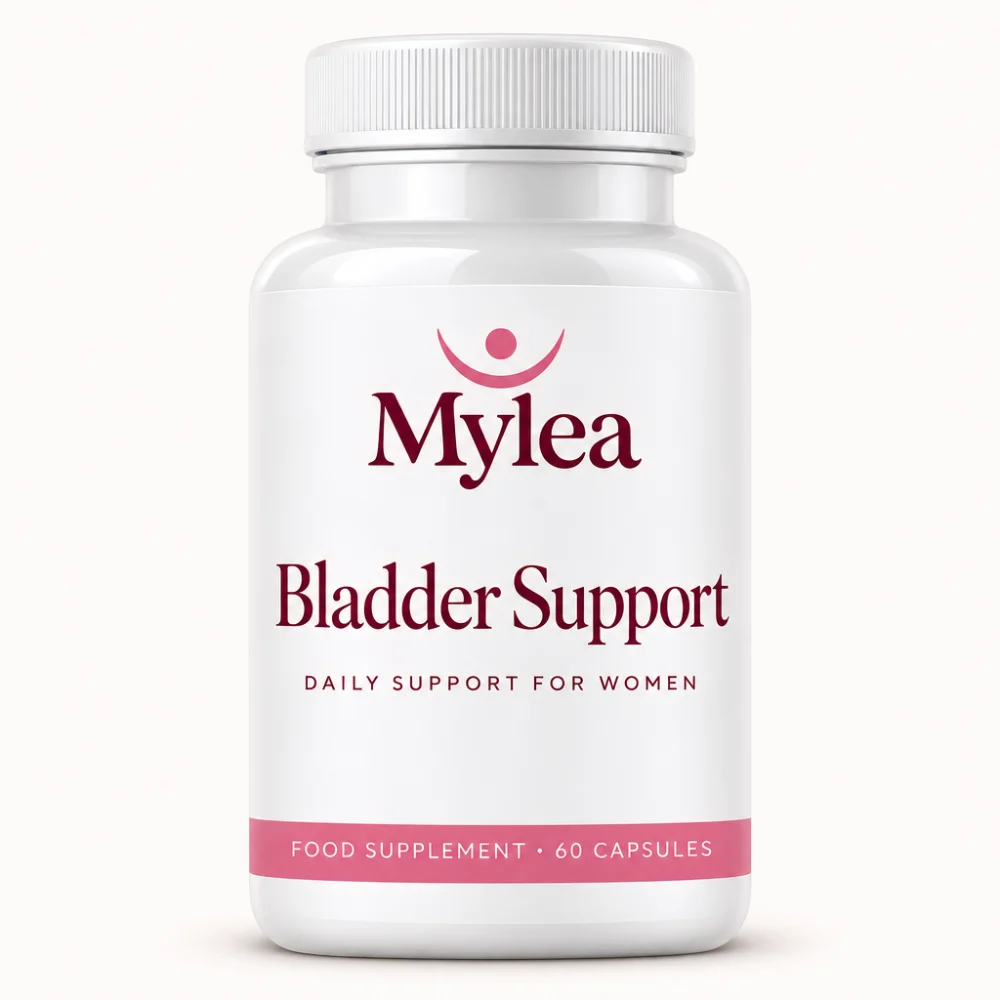
This is the thinking behind Mylea Bladder Support: one daily formula that gives the body nutrients connected to each of the bladder's supports, instead of focusing on a single one. Two capsules with breakfast. That's the whole routine.
Pumpkin seed extract: for bladder comfort
A traditional ingredient for bladder comfort, studied in women with an overactive bladder.
Magnesium citrate: for the hammock and the signals
Magnesium contributes to normal muscle function and to the normal functioning of the nervous system: the two things the bladder relies on to hold, relax and send accurate signals.
Hyaluronic acid: for the lining
A natural part of the bladder's own protective coating, included to support the body's supply.
Cranberry extract: for the urinary tract
Contains natural compounds that have been widely studied for urinary tract health.
Red clover extract: when oestrogen falls
A source of plant isoflavones, compounds structurally similar to oestrogen, included for women whose levels have fallen.
Sea buckthorn: for delicate tissue
A rich source of omega 7, included for the health of the delicate tissue of the urinary and intimate area.
You may already have tried one of these on its own. If the Hysterectomy Echo affects three supports, working on one is like fixing the sticking door and ignoring the missing wall. Mylea Bladder Support puts all six together so the hammock, the lining and the signals are each covered every single day.
What Customers Report After 8 Weeks
Post-purchase survey of 10,000+ customers. Individual results may vary.
"I had my hysterectomy twelve years ago. Twelve years of thinking this was just what getting older felt like. Week three I realized I hadn't mapped out the toilets before leaving the house. I just left. Got in the car, drove to my daughter's. Didn't plan a route around service stations. I sat in her driveway for a moment when I arrived and thought — when did I stop doing that? Twelve years ago."
Susan B., 67, Manchester✔ Verified
"My surgery was at 49. By 61, I was getting up four times a night. My husband moved to the spare room. After six weeks I was down to once, sometimes zero. He's back. That sounds like a small thing and it is not a small thing."
Patricia K., 63, Leeds✔ Verified
"I had an accident at my granddaughter's school recital. Front row center. Nobody saw but I knew. I drove home and cried in my car. Eight months later I haven't missed a single event."
Dorothy K., 63, Birmingham✔ Verified
What to Expect (Honestly)
This won't work overnight, and anyone who promises that is selling something else. Mylea is daily nutritional support, not a medicine that suppresses symptoms, which is why the full eight weeks matter.
→ Days 1 to 10 You'll probably notice nothing. This is normal; nutrients take time to build up.
→ Weeks 2 to 4 Some women notice small things first: one less trip in the night, a little more warning before the urge.
→ Weeks 5 to 8 This is when changes tend to become noticeable in daily life: fewer surprises, fuller nights, more yes to plans.
→ Week 8 onward The aim is simple: thinking about your bladder less, and planning your day around it less. Everyone is different, which is why the promise lasts ninety days.
You Have Three Choices From Here
There are three realistic paths. Here's what each one can and can't do.
Try Mylea Bladder Support for 90 Days
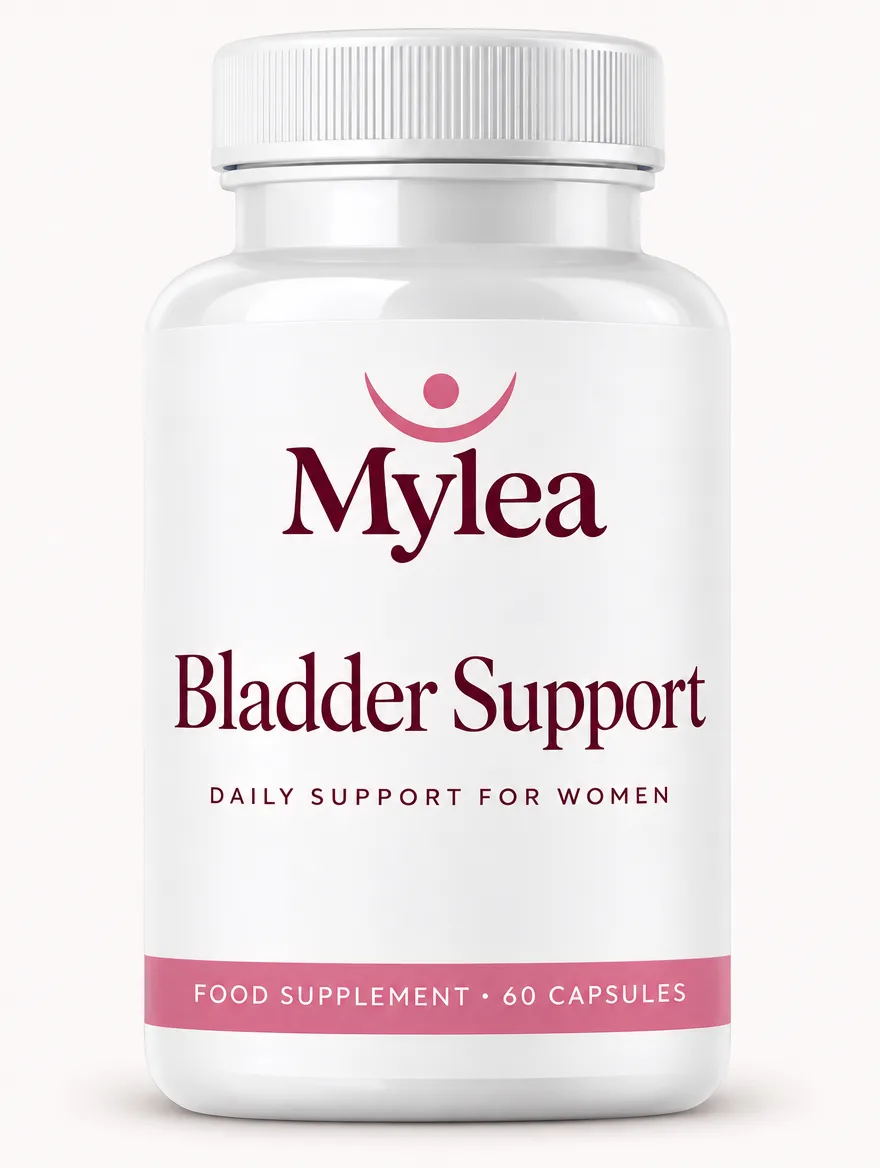
Mylea Bladder Support brings the six ingredients together in two capsules a day, taken with breakfast. No prescription needed, no artificial additives, and free tracked UK delivery.
It's called Mylea Bladder Support . On the three bottle option it works out at about 56p a day, less than a cup of tea, for support on all three fronts. Every order comes with a 90 day money-back promise: give it the full eight weeks, and if you don't feel the difference, contact us within 90 days for a full refund.
"It isn't just what getting older feels like. It's what a bladder feels like when its supports have changed. And those supports can be helped."
Picture an ordinary Tuesday. You leave the house without checking where the toilets are. You laugh at something your grandson says, properly, without bracing. You sleep through to the alarm, or near enough.
Nothing dramatic. Just this: the feeling of being yourself again, rather than someone managing a problem.
So why has nobody mentioned it? Not because anyone is hiding it. The research on how hysterectomy and menopause affect the bladder's supports has been published for years, but it sits in specialist journals. A GP appointment lasts ten minutes, and the quickest honest answer is "it's common at your age". Nobody's job is to join the dots ten years later.
So women go on buying pads, cancelling plans and waking at 3am, because they've been told this is simply what getting older feels like.
It isn't. It's the Hysterectomy Echo, and it can be supported.
You've spent years working around this. You've earned the chance to stop. That's what the next ninety days are for.